Caterpillars, Scorpions, Frogs, Oh My!
If I told you that eating insects could solve world hunger, would you do your part and eat a bug? That’s what entomophagist (a person who…
If I told you that eating insects could solve world hunger, would you do your part and eat a bug? That’s what entomophagist (a person who eats bugs), Daniella Martin, argues in her book, Edible. I’m intrigued by the idea of insects as a nutritious food source. Crickets are 65% protein by weight! That’s way more than a filet of salmon, which clocks in at around 20% protein by weight.
Now, you must be wondering, “Connie, do you eat bugs?” And technically, the answer is yes! Just not intentionally. As a vegetarian, I graze on a lot of veggies and I enjoy it, but inevitably, those leafy greens will have a few hitchhikers that I miss and I’ll inadvertently cook them up and eat them without ever knowing. However, that’s as far as I’ll go when it comes to eating insects. While I can’t stomach putting grasshoppers in my mouth, I love seeing how other cultures do not shy away from this sustainable food source.
The first time I saw edible bugs on sale was on the streets of Nandaemon in Seoul. I thought it was such a novelty to see street vendors selling vats of braised silkworm pupae, a byproduct of silk production. I appreciate the logic, since thousands of cocoons are required to make just one yard of silk fabric. It would be a waste to not make full use of everything, like throwing out the hide after slaughtering a cow for meat.
I didn’t expect to ever see bugs for human consumption again, but Thailand has been a series of surprises. Like everything in Bangkok, they take eating insects to the next level.
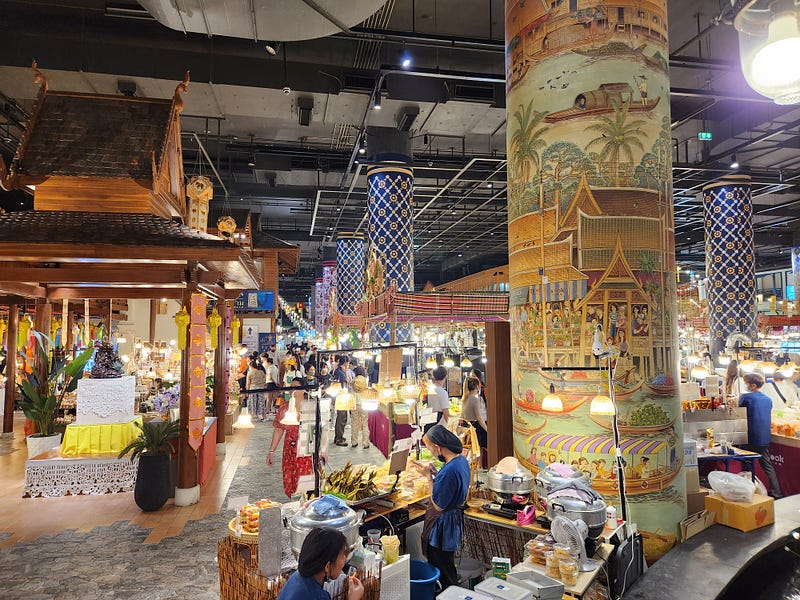
Bangkok is incredibly humid and hot in the summer, so I prefer to stay indoors where the air conditioning is blasting icy cold air. This weather limits your options to exploring authentic street food, but ICONSIAM — the largest shopping mall in Bangkok — has a wonderfully themed section where street vendors offer their delicious delicacies in the comfort of climate control. This is where I found a vendor who offered a selection of creepy, crawly bugs.
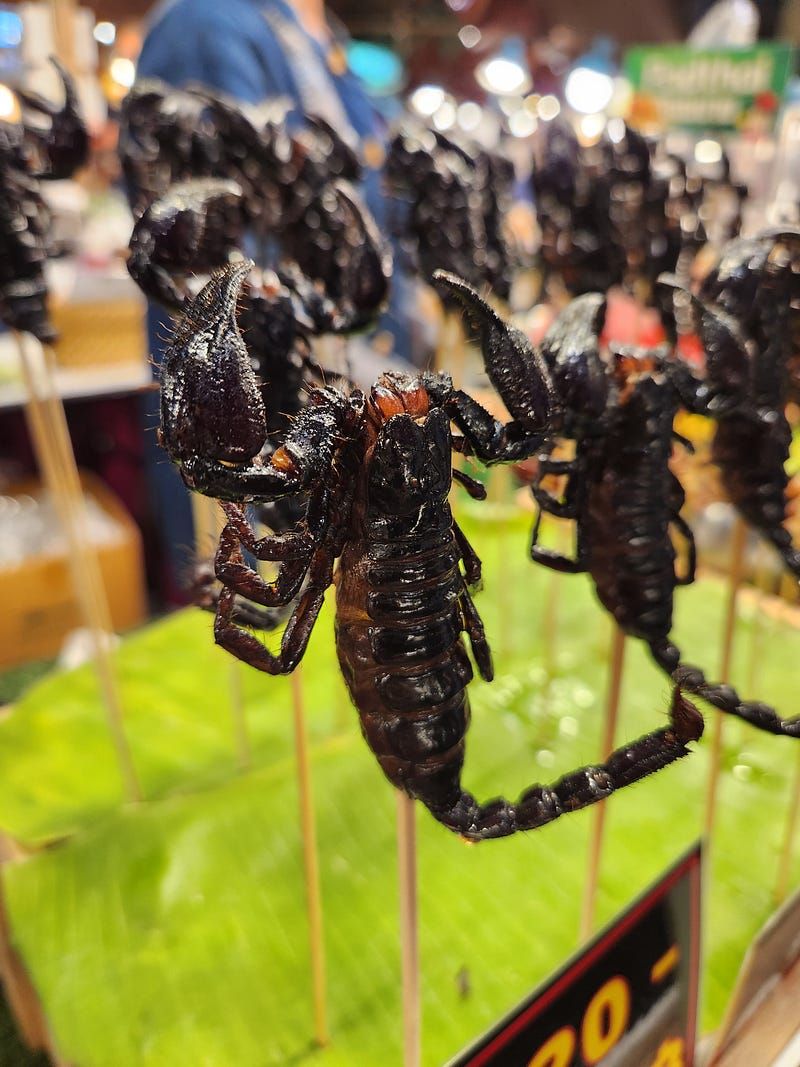
The first thing that caught my eye was scorpion skewers! Imagine you’re a contestant on Iron Chef and the ingredient they reveal is scorpion. Where do you even start? How do you take a venomous, live arachnid (scorpions are related to spiders) and turn them into what looked like candied apples shaped like a scorpion (with stingers intact!)? And how do they even find that many scorpions to roast? Do they farm them? Can you imagine being a scorpion farmer? What does it taste like? I’m guessing it’s probably crunchy? My head was filled with so many unanswered questions. Usually, when I have this many questions, my instinct would be to just buy it and satisfy my curiosity. Unfortunately, on top of being a vegetarian, I can’t get over the “eww” factor.
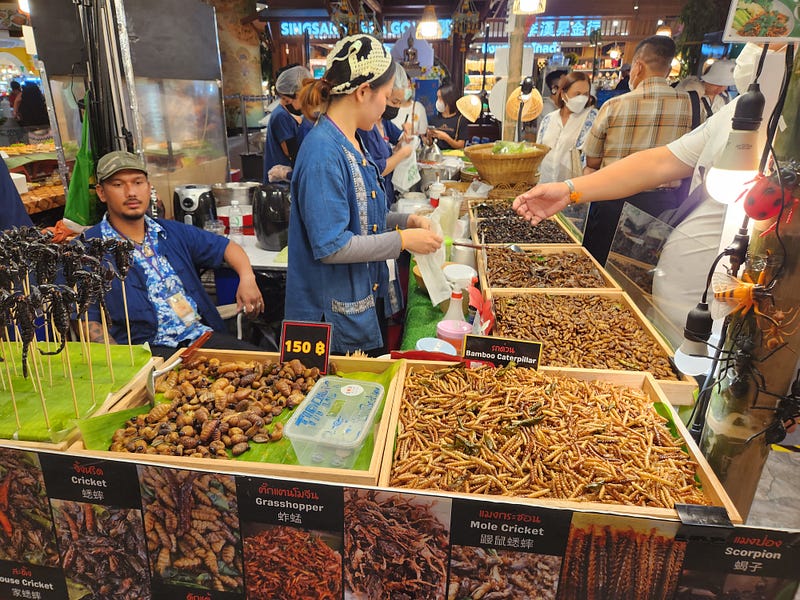
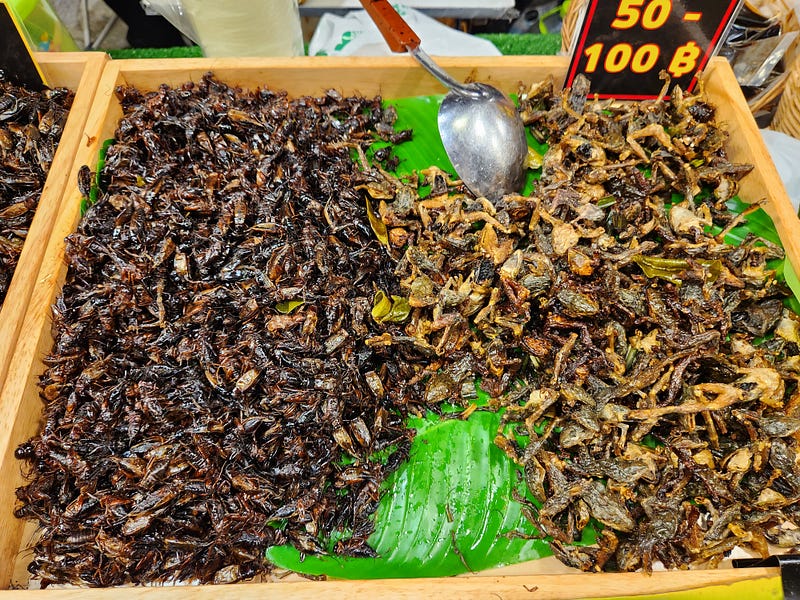
Other bugs offered were also roasted or deep fried to a deep golden crisp. They had grasshoppers, crickets resembling cockroaches — which were surprisingly absent from the bug buffet — pupae of an unspecified insect (most likely silkworms), and bamboo caterpillars that were so thoroughly fried that they puffed up, making them look like crinkle cut French fries with little legs attached on one end. If their texture was anything like a French fry, I can see why people would munch on them. I wondered how many tourists actually tried eating the bugs. Considering how patient and non-pushy the vendor was, I’m guessing not many. I felt a little bad for lingering so long over his stall without buying anything. He’s probably seen it a million times, the overly exuberant tourist who takes tons of photos but is too scared to try his traditional recipes.
Bugs weren’t all that he offered. On the edge of his stall, he had whole, deep-fried frogs. They didn’t specify the type of frog, but from the looks of it, it was a small frog not much bigger than the crickets in the pile next to it.
Since we’re on the topic of frogs (and as this blog post seems to be all about the unconventional foods people eat in Southeast Asia), I want to mention another froggy ingredient that I ran across.
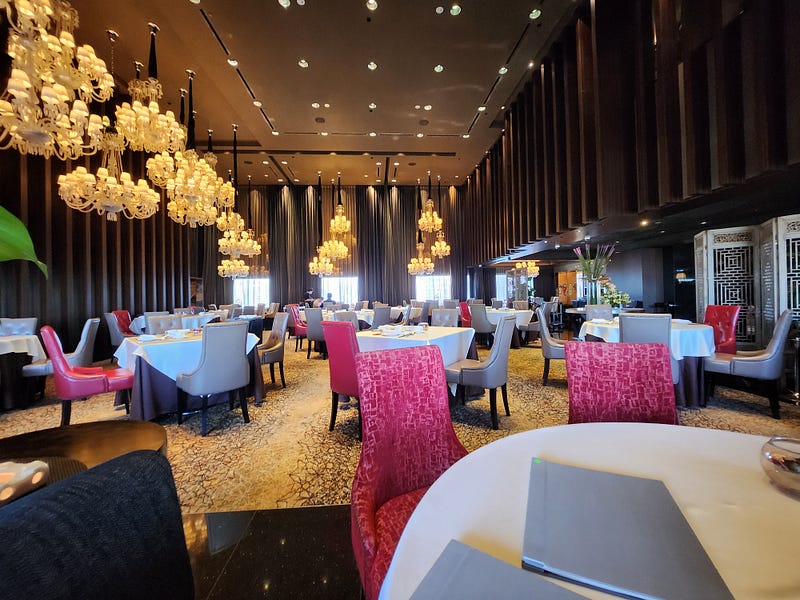
We decided to have dinner at Shisen Hanten (四川飯店), a two Michelin star restaurant opened by Chen Kentaro (son of Iron Chef Kenichi).
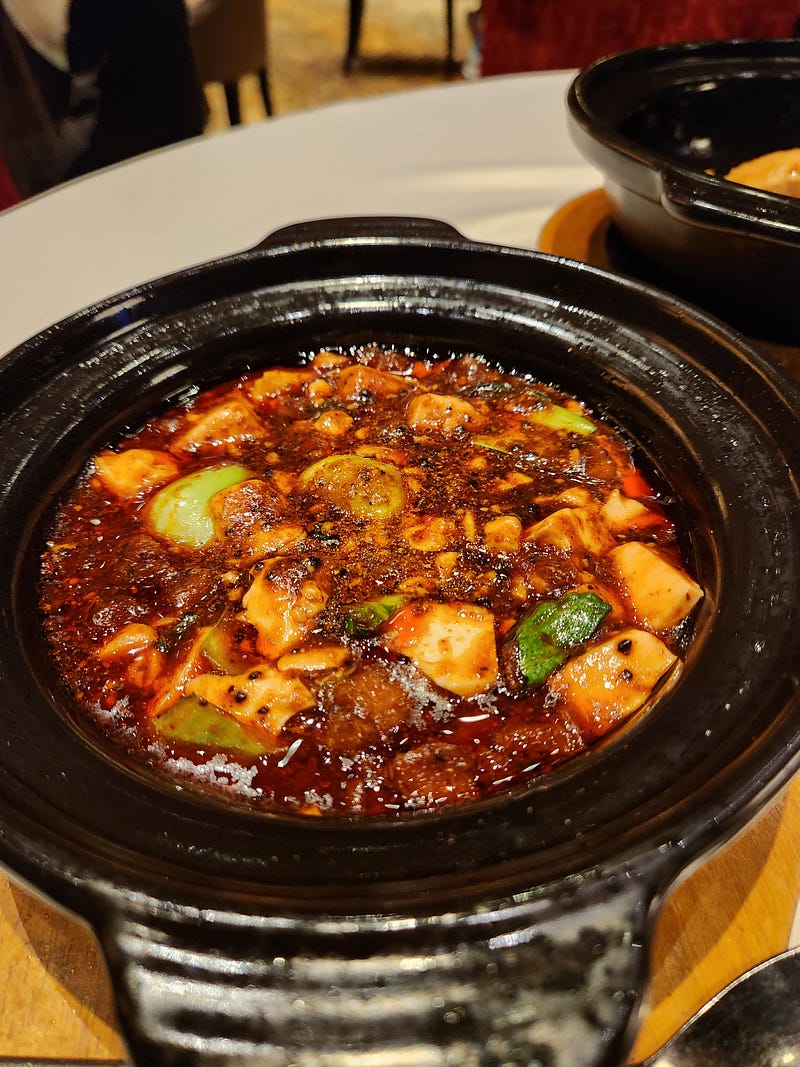
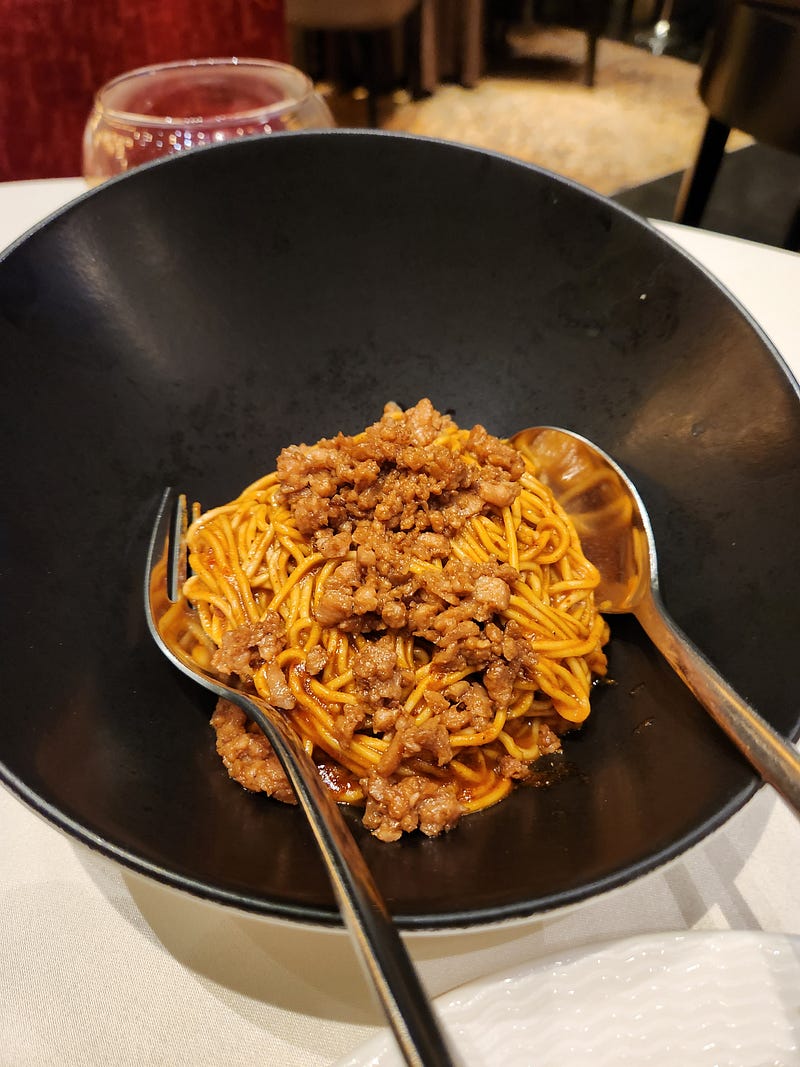
This was a rare treat because there are relatively few Chinese restaurants with such a high rating. Most Michelin starred restaurants are fancy French restaurants (the Michelin guide is French, of course). At Shisen Hanten, we were overjoyed to find a menu that had a full vegetarian section and even a vegetarian prix fixe (French for fixed price) menu. We came in hungry, so we decided that the prix fixe wasn’t going to cut it. We wanted a banquet and tried almost every vegetarian option. With appetizers, two soups, two bowls of noodles, fried rice, and three entrees, we were clearly going to have to ask for a doggy bag.
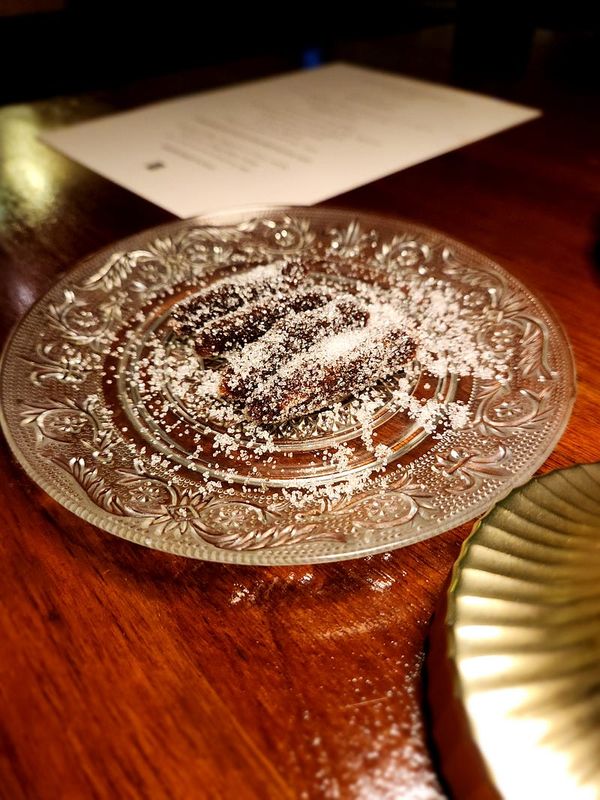
When the dessert menu came out, I appreciated the traditional selection of treats, but was surprised at some of the options. Most of the time, we think of desserts as something that’s vegetarian (you wouldn’t find pâté in a cheesecake!), so it was odd to me that this menu had a couple of non-vegetarian desserts.
The first was double-boiled hasma with American ginseng and red dates, while the second was almond pudding topped with bird’s nest. Bird’s nest — the actual nest of a swiftlet composed of its vomit — was not surprising, since most fancy Chinese restaurants like to serve this. It’s considered a delicacy like shark’s fin. Since swiftlets eat fish, it’s not considered vegetarian, and the thought of eating a bird’s regurgitation doesn’t appeal to me. On the other dessert, it listed something called hasma, which I had never heard of, but it’s a weird froggy ingredient I have to tell you about.
Hasma is the dried fatty tissue above the fallopian tubes of the Asiatic grass frog. Isn’t it strangely specific? Why meat from above a frog’s reproductive organs? How did they come upon this? And how did it become a sought after luxury? If it has anything to do with traditional Chinese medicine, I wouldn’t be surprised if it treats erectile dysfunction like tiger penis does, which is total bullshit! There’s absolutely no science when it comes to a lot of these health claims.
For many of us who grew up in Western cultures, it’s hard to fathom ingesting some of these ingredients. We grew up with the assumption that bugs, arachnids… bird regurgitation… and frogs are taboo at best, and “unsanitary” or “gross” at worst.
But when you travel and experience other cultures, these preconceived notions are challenged, putting them more in a broader perspective, because in many other parts of the world, no rock is left unturned when it comes to sustenance. Everything is game for food. If it can be eaten, it will be eaten, and this nothing-goes-to-waste mindset is something I respect. It’s a way of living that’s a more efficient use of the resources available, so it’s better for our planet. If people were more open to eating some unconventional foods, like bugs, maybe the world would be a better place. Though perhaps this is all wishful (and hypocritical) thinking since I can’t even get myself to chew on some grubs!