Massaman Curry
Ever go out to a restaurant and taste the most amazing dish, only to have no idea what you just ate? Like it was an amalgamation of flavors…
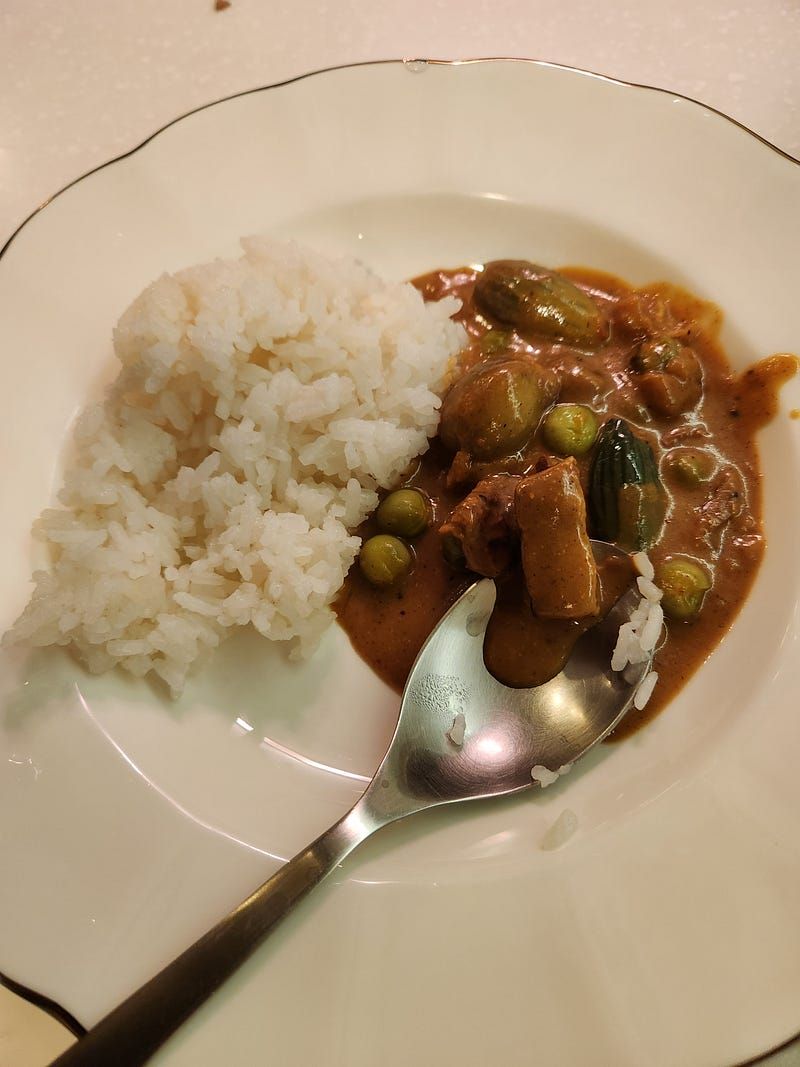
Ever go out to a restaurant and taste the most amazing dish, only to have no idea what you just ate? Like it was an amalgamation of flavors so delicious that it short circuits your ability to even describe it? That’s what it’s like to eat in Thailand.
Nothing that I’ve eaten in Thailand has disappointed me — the flavors are out of this world. One taste of their creamy tom yum soup (I had no idea this hot and sour soup even came in a creamy version) will blow your mind, and your sinuses! Sadly, Thailand is nothing like India when it comes to options for vegetarians. More than half the time, the restaurants that look promising would have literally nothing we could eat. While there are definitely places that offer vegetarian food, they are few and far between, so you end up spending more time hunting for food, leaving you feeling hangry.
Fortunately for my own sanity, I love cooking and the supermarkets here are gloriously stocked. Even though Thai cuisine is intimidating and I’m not confident I can make authentic Thai, I vowed to master at least one new dish while visiting Bangkok. One reason I think Thai food seems impossible to master is their heavy use of seafood. Like Japanese food, everything has a fishy taste; Thai people use shrimp paste and fish sauce the same way Japanese people use bonito flakes (razor thin slices of preserved skipjack tuna). This makes life as a vegetarian cook difficult, since it’s hard to reproduce that fishiness with plants.
I’ve tried making my own fish sauce using kombu (a type of kelp) and seaweed simmered in a broth of soy sauce. It wasn’t bad, but not nearly as fishy as real fish sauce. I’m looking forward to trying a new recipe I found recently that adds marmite to the mix, and I’m hoping that will give it the funk that my vegan fish sauce needs. In the meantime though, I found two brands of vegan fish sauce in Bangkok, so I lucked out!
The top five Thai dishes you’ll find in America are kaeng khiaw waan (a creamy green curry), phat thai (stir fried rice noodles), som tam thai (papaya salad), tom yum soup (hot and sour soup), and khao nail mamuang (mango sticky rice). All classic dishes that I’ve attempted with some degree of success. While I still need practice with the dishes I know, I wanted to expand my repertoire, so we went out to find new dishes to try.
The local shopping mall near our AirBnB apartment is called Terminal 21 and themed as an airport terminal with various destinations you can visit. It’s quite a creative and unique shopping mall and they have an outstanding food court. Even though most of the food was seafood and meat-centric (*cry*), they had one stall simply called “vegetarian,” like an oasis in the Arabian desert!

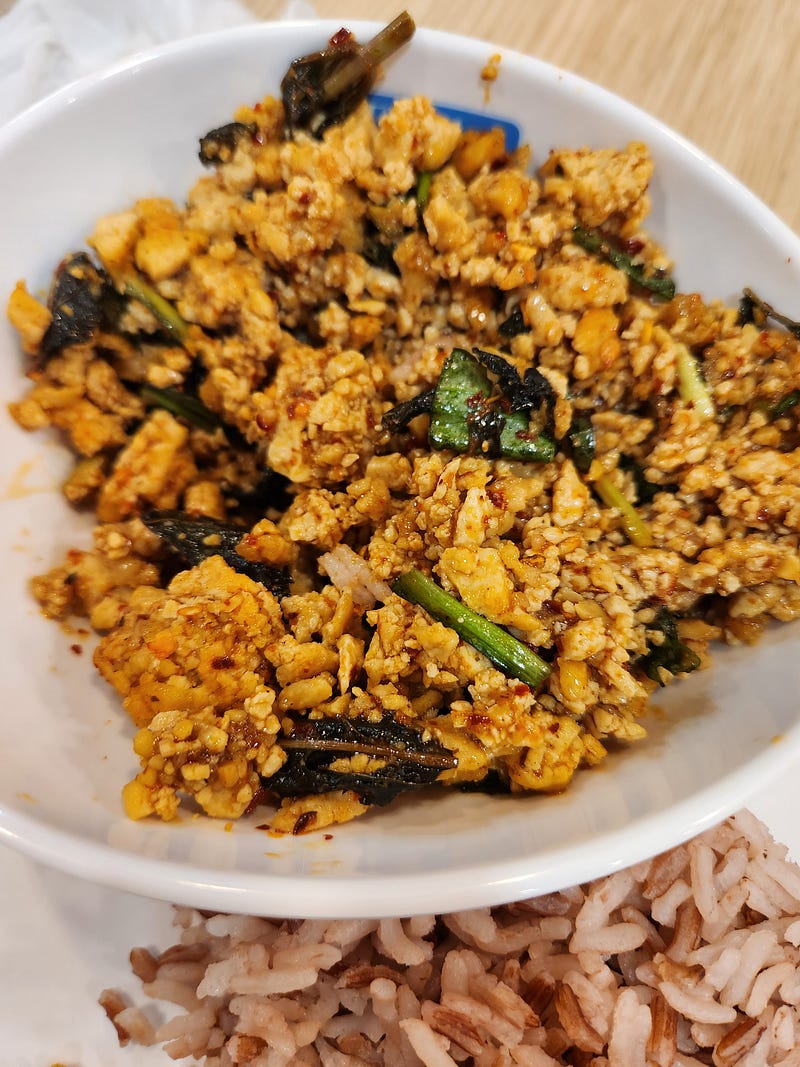
Due to our jet lag, we arrived at the food court later in the day, so many of the dishes we wanted had sold out. The remaining food seemed to have been sitting out, buffet style, like leftovers that had been picked through. Disappointed, we ordered a spicy tofu dish to satisfy our hunger, but immediately planned on where else we could go to get a real meal.
As we sat down in a sea of locals, we were not thrilled by the look of the tofu — plain, bland, and run-of-the-mill, like something you’d whip up for a weeknight dinner because you’re busy. As I raised a spoonful to my mouth, I mentally prepared myself for crumbly, underwhelming, mediocre tofu bits.
Then, we had our first bite.
Crazy fireworks! It was a flavor party in my mouth! The taste was completely unexpected. For some reason, I had mapped the dish to traditional Chinese food, so I was expecting Chinese flavors. Instead, I got powerful Thai flavors that instantly took the dish from a five out of ten to a ten out of ten! We were impressed and immediately ordered two more dishes, spending a grand total of 100 baht, which is equivalent to $3 US dollars! Incredible value for a delicious meal for two! With prices like this, you can live like royalty in Bangkok.
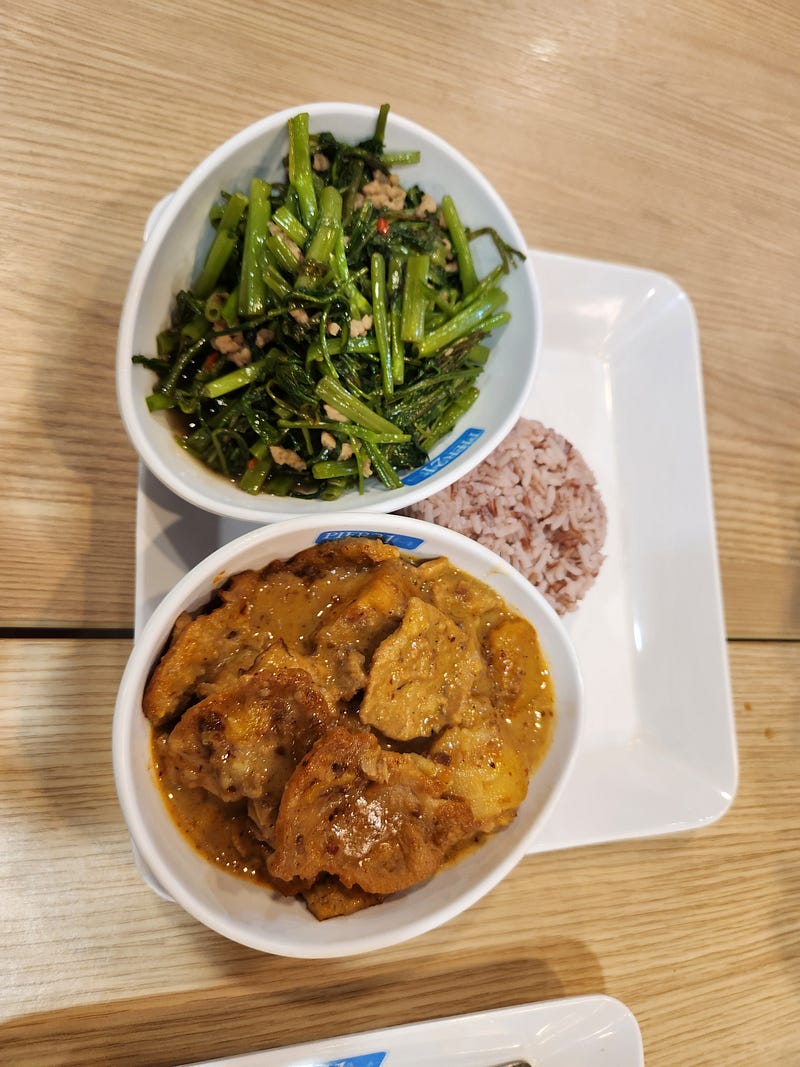
And if we thought we were eating like royalty with a $3 tofu dish, what we ate next was a dish fit for a king. One of the dishes we ordered after the tofu dish was a Massaman curry, which was luxuriously rich. The creamy brown curry was sweet, salty, tangy, spicy, and umami all at the same time. The balance of flavors was masterful, and I knew immediately this was the dish I would learn to make while I was in Thailand. Like the raj kachori in India, I needed to make this dish; I needed to be self-sufficient on this. I cannot bear to be at the mercy of others to fulfill my food desires.
When it comes to learning new cuisines, I like to reference multiple cookbooks. Quality Thai cookbooks in English are harder to find, but there are a few that are worth the money — in particular, cookbooks by David Thompson and Andy Ricker. Following their recipes has never led me astray, but since this is Thai food, it’s harder than usual to adapt the recipes to be vegetarian. So for the Massaman curry, I adapted a recipe from Rosa’s Thai Cafe, an awesome vegetarian Thai cookbook, to match the version I had at the food court, primarily by substituting the crushed roasted peanuts with a creamy peanut butter.
To my surprise (usually I don’t get Thai food right on my first try), the resulting curry tasted exactly like the one from the food court! If I had to guess, it wasn’t entirely my fault that Thai food was so difficult in the past. When you don’t have access to the freshest ingredients, like lemongrass or galangal (both of which are iffy when I find them in the US), you’re bound to struggle with reproducing the flavors. So, next time you try making Thai food, don’t despair and don’t give up! It is possible to recreate Thai food outside of Thailand, but when you have an opportunity, come to Bangkok for flavors as wild as their nightlife.