An easy way to eat your favorite foods and not get fat.
Forget diet food or diet plans that deprive you of the food you love. Health is multifaceted and we don’t need to be nagged about what to…
Forget diet food or diet plans that deprive you of the food you love. Health is multifaceted and we don’t need to be nagged about what to eat. Truth is you already know what’s healthy. Instead, let’s focus on what we love about food and why we eat it. I posit that there are only two reasons to eat food:
- For pleasure, because it makes us happy.
- For health, because we want to maximize the time we get to do #1.
This culminates to a simple philosophy I’ve come up with: Don’t Eat Shit.
When you embrace the Don’t Eat Shit philosophy, it makes deciding what to eat very easy. 1,000 calories of the best god-damned rice cakes in the history of rice cakes? Get in my belly. Cointreau Creme Brulee donut choke full of sugar and refined carbs? Yes, please.
Stop beating yourself up for cheating on the latest trendy diet you’re on. With Don’t Eat Shit, you’re freed of guilt, because when you eat something delicious, you’re true to yourself — you’re increasing your happiness! Just make sure whatever you put into your mouth truly isn’t shit.
This means that when you go to a local ramen joint, the moment you finish your first bite, stop and ask yourself: is finishing this going to serve rule #1 (for pleasure)? If not, then ask yourself, is finishing this going to serve rule #2 (for health)? If neither, then, flag the waiter down and politely pay your bill. You’ve learned an important lesson. You hate overcooked noodles, MSG-laden soup, and this restaurant sucks.
But, that’s easier said than done. The human mind loves playing games with itself. You will experience conflicting cognitions when you initially employ Don’t Eat Shit. You will be tempted to fool yourself that you really are eating for pleasure or for health to assuage your internal turmoil. I’ll give you a few examples and teach you how I manage to think of each.
I just wasted good money for shitty food!
Money doesn’t grown on trees, so it hurts to waste money on shitty food. You might feel angry, annoyed, frustrated, but is the answer to eat it because you paid for it? If you think about it, that would be absurd. So, what’s a better perspective on this situation?
I like to borrow Marie Kondo’s method of dealing with clothes you bought but never wear. When you feel guilty that you spent money to buy something you never wear, simply thank the garment for teaching you that you don’t like wearing that type of clothing and send it on its way to provide joy to someone who will cherish it more. Consider the money paid as the price for that lesson.
You can apply the same method to spending money for something you don’t like eating. Consider it as the cost of learning your food preferences. As long as you are learning, your money was well spent. You don’t need to suffer the experience of eating shitty food, too.
It’s such a waste of food if I don’t eat it.
This one is similar to wasting money and I have a long Chinese heritage that haunts me with this tenet. “Your grandmother ate tree bark and mud when she escaped communism. Don’t waste food!” my mother would scold me. It’s a constant battle on this one, but let me tell you how I deal with this as an adult.
I have a friend who loves melted ice cream. I HATE melted ice cream. It’s always a race with the clock when I eat ice cream. As soon as you hand me ice cream, I get tunnel vision and the only thing on my mind is to finish it ASAP before it’s a puddle of milk — which I find disgusting. My friend, on the other hand, loves it because it’s like leftover milk from a sugary breakfast cereal. Now, I’m not saying my friend would drink my milk puddle, but the point is something that you hate maybe something that your friend loves. You may find that your friend loves those beet cookies you thought were “meh”, so why not let them derive more joy out of it. If you can’t find a friend, you can donate the food to a soup kitchen or give it to the homeless. There’s always someone who will appreciate it more, so stop worrying about wasting food. Even at the dumpster, some seagull or microbe will find it irresistible. Look how thankful pizza rat is!
I’m hungry, crammed for time, and need the calories to get back to work.
Hunger is a primal, powerful feeling, but we no longer live in prehistoric times. For most of us, there is no danger of starvation in modern society; our rates of obesity in the U.S. indicate quite the opposite. You are evolved to go a little hungry at times, and an occasional fast is actually good for you! It will be hard. It will be uncomfortable, occasionally unbearable. You might get hangry. But, you will survive and your body will thank you. I don’t expect you to take my word for it, but I encourage you to try! Really, it works.
Bottom line is DON’T EAT SHIT. Not for hunger, not for money, not for food waste, not for guilt. There are only two reasons to eat food: for pleasure or for health — which in the end serves to maximize pleasure!
To eat, or not to eat, that is the question.
But, Connie, I hate vegetables, especially brussels sprouts. They taste like shit, but I know it’s healthy for me and I should eat more of it. How does that square with Don’t Eat Shit?
Good question. This is the beauty of Don’t Eat Shit. I like to call this Schrödinger’s Shit — the quantum superposition of simultaneously being shit and not shit. Okay, I won’t get weird on you, but what I mean is that the word shit has double meaning. Yes, brussels sprouts taste like shit, but is it shitty to your body? I think experts would agree with an emphatic no. So brussels sprouts are both shitty (to taste) and not shitty (for health).
So how do you decide? Well, this is where you come in. It comes down to your intention. Why are you eating it? For example, if you love the taste of peaches and it’s also healthy, then which is it? For health or for pleasure? In Don’t Eat Shit, there’s only one option and it’s down to your intention. Pick one.
That is why no one has the magic formula that can tell you when to eat for pleasure or for health. And until Google achieves quantum supremacy and our AI overlords take over, no one will. It’s up to you to find out for yourself, and that’s the fun part! But first, let me equip you with the right tool.
Cavemen don’t get fat.
Don’t worry, you won’t need a fancy FitBit or smart scale. All you need is some cavemen — and women! — technology, a method of recording things. Yes, it’s boring, perhaps tedious, but I don’t care how you do it, even if you have to carve your records on cave walls, make it a habit to record what you eat. It’s the only way you’ll figure out what to eat and what not to eat. Don’t believe me? A Kaiser Permanente study found that keeping daily food records can double a person’s weight loss. This shit is real, so make it a habit! You can use the trusty pen and paper, a Word doc, Excel, even Facebook or Instagram. Of course, I recommend the Tasty Time app, because I’ve designed it with the Don’t Eat Shit ethos, but anything will do, as long as you do it consistently.
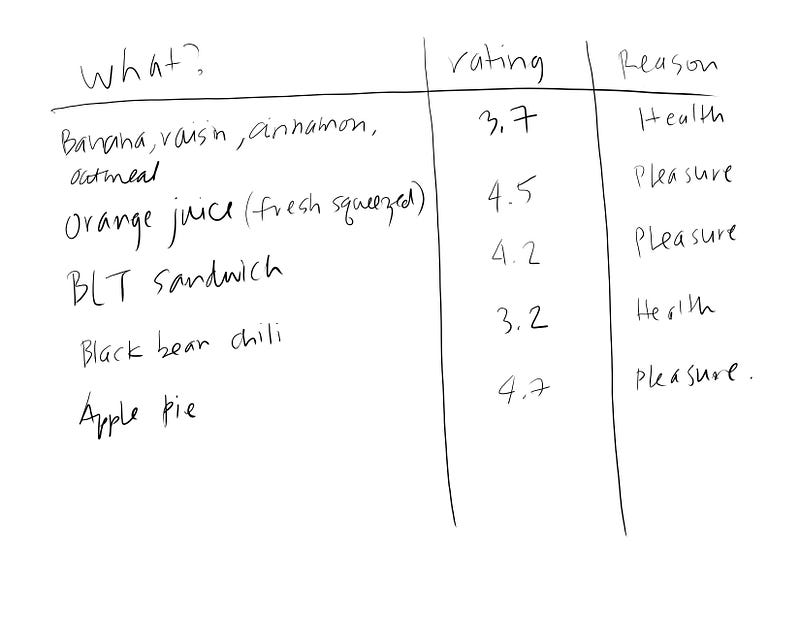
Okay, so you have your choice of weapon! What are you recording? Three simple things:
- What are you eating?
- How good it tastes on a scale of 1 to 5?
- Your intent. Am I eating it for health or for pleasure?
So it might look something like this:
At the end of each day, you will need to do a little bookkeeping. Don’t worry, it’ll only take a minute, so grab your casino visor, Tiffany lamp, and a calculator.

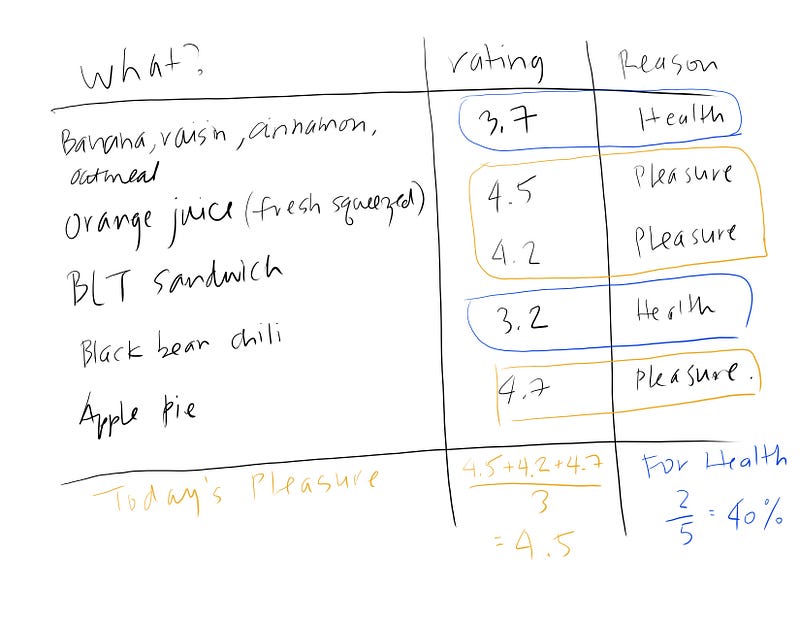
You will compute two numbers:
- Pleasure Rating — Calculate the average rating for all dishes that you categorized under pleasure.
- Eating for Health Percentage — Calculate what percent of what you ate was for health.
So now your record will look something like this:
So, what do these numbers mean? And why do they matter?
The pleasure rating tells you how well you’re eating for pleasure. The higher this rating, the higher your standard is for not tolerating shitty food. The eating for health percentage tells you how much of your day you dedicated to eat for health. You also want to maximize this number for obvious reasons. These two numbers are the pillars to living the Don’t Eat Shit life.
Your goal is to find that happy balance between a high pleasure rating and a high eating-for-health percentage. They act like a stopwatch that you use to race against yourself to maximize pleasure and health, the only two reasons you eat food.
Over time, you’ll discern patterns and learn what your daily pleasure rating cut off is, say “I won’t eat anything that’s a 3.2 or lower.” and what your minimum daily eat-for-health percentage is, like “I will eat for health 50% of the time everyday”. When you review your records, you’ll learn which foods bring you the most joy. Your daily habit will force you to think each time you eat. It will force you to decide what your intentions are when you put food in your mouth.
Back to the beginning.
From a family of foodies, I struggled with the love of good food and the need to stay healthy. Having been on the yo-yo dieting treadmill, I know it doesn’t work. Food is too personal to fit into a set of dietary constraints. I wanted a framework that considered the emotional aspects of eating. Maybe I’ve been stating the obvious. Maybe it’s too simplistic. Maybe I’m just plain crazy. But deep inside each of us, I believe we live by a single rule. We all want to maximize our happiness. That is what all the gurus and experts leave out of the equation. They never talk about our happiness and how food is a big part of it.
Don’t Eat Shit won’t help you squeeze into your high school jeans in two weeks or cure your blood pressure or glucose readings. It is agnostic to nutritional theory — which is constantly changing and evolving with the latest research. Instead, Don’t Eat Shit gives you the tools to think about why you eat and how it makes you feel both emotionally and physically. It states that we eat for ONLY two reasons: for pleasure or for health. Put another way, it’s asking you:
- Is eating this going to make me happy emotionally?
- Is eating this going to make me happy physically?
These are the only two questions that matter, IMHO. It’s that simple. Find the right balance between the two and you’ll find your happiness. I know it’s helping me find mine.
Tasty Time and Don’t Eat Shit are works-in-progress. I’d love to hear your feedback. Please like, comment, and follow for more posts like this. Thanks for reading!